Ridge repairs · 10 min read
Roof Repointing Cost Melbourne: 7 Signs Your Ridge Caps Need More Than a Patch
The 30-second answer
Here’s the straight version.
Published Melbourne guides currently place straightforward ridge-cap repointing around $40–$90 per linear metre, with many complete jobs landing in the low thousands. That is a planning guide, not an Apex quote. The decisive question is whether the mortar bedding beneath the pointing is still sound. If ridge caps are loose, the bedding is hollow or crumbling, or sections have moved, rebedding plus repointing may be required—and the scope and price change materially.
See what Apex’s roof repairs service includesPointing, bedding and ridge caps—in plain English
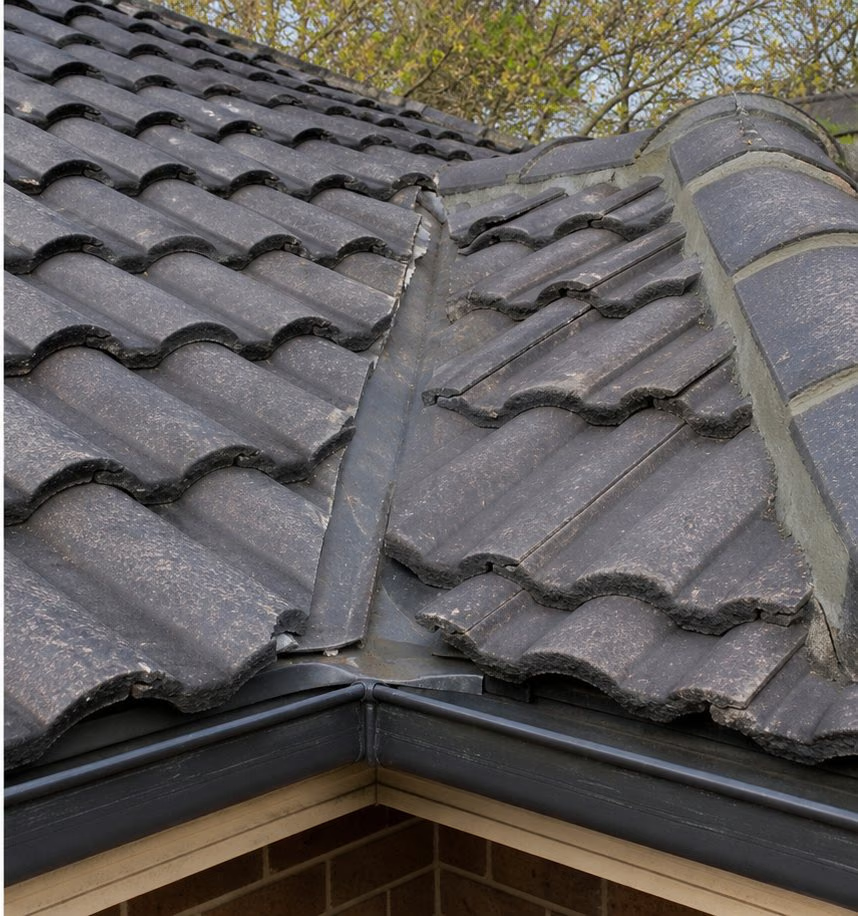
The ridge caps are the shaped tiles running along the peaks and hips of a tiled roof. They close the junction where two roof faces meet. Beneath each cap is bedding: the mortar that supports and positions it. Pointing is the exposed finishing layer along the edges of the cap. It seals the bedding and helps secure the ridge line.
That two-layer construction explains why “the ridge cement is cracked” is not a complete diagnosis. Surface pointing can split while the bedding remains firm, making repointing a sensible repair. But if the bedding has lost its grip, broken apart or allowed the cap to move, applying fresh pointing over it is like painting over loose plaster. The visible finish may look new while the foundation underneath is still failing.
The Building and Plumbing Commission describes Victorian roof-tiling work as including repair and renovation activities such as bedding and repointing. Monier likewise distinguishes the supporting mortar bed from the flexible pointing layer applied over it. Those are not interchangeable words on a quote; they describe different work.
What roof repointing costs in Melbourne in 2026
There is no responsible fixed price without knowing the length and layout of the ridge line, roof height and pitch, access, existing mortar condition and the number of caps that have moved. Third-party Melbourne guides published in 2026 commonly quote roughly $40–$90 per linear metre for repointing. Other local guides place smaller or straightforward repointing jobs around $800–$2,000, with larger, complex roofs extending beyond that.
When rebedding is required, the caps must be lifted, failed mortar removed, a new bed formed, the caps aligned and then pointed. Published local planning ranges for combined rebedding and repointing commonly extend from about $1,500 to $4,500. These figures are market orientation only: they are not Apex pricing, and two roofs with similar floor plans can have very different ridge lengths and access requirements.
Scroll sideways to see all columns →
| Scope driver | Likely price effect | Why it matters |
|---|---|---|
| Repointing over sound bedding | Lower | The ridge caps remain seated; the failed exposed layer is renewed |
| Lift, rebed and repoint | Higher | Removal, mortar work, alignment and a new finish are required |
| Many hips, valleys and small roof planes | Higher | More linear metres, junctions and hand detailing |
| Steep, high or restricted-access roof | Higher | Access planning and fall controls become more involved |
| Broken caps, adjacent tiles or valley defects | Higher | Additional components and repair work must be included |
Seven warning signs worth investigating
A hairline surface crack does not automatically mean the whole roof needs rebedding. Equally, a tidy-looking ridge does not prove the underlying mortar is sound. Water may also be entering through flashing, a cracked tile, a valley or another detail and travelling before it becomes visible inside.
Use these signs to trigger an inspection, not to self-diagnose from a ladder. WorkSafe Victoria identifies falls as the most serious risk associated with roof work. Ground-level photographs and safe internal observations are useful; walking the ridge to “have a look” is not.
- Cracks running along the edge of the ridge cap, especially where pointing has separated from the tile.
- Chunks of mortar or coloured pointing appearing in gutters or on the ground after wind or rain.
- Ridge caps that look crooked, lifted or uneven when viewed safely from ground level.
- A cap that visibly rocks or has a hollow, unsupported section—something for a trained professional to assess, not a homeowner to test on the roof.
- Damp marks or drips beneath a ridge or hip, particularly during wind-driven rain.
- Repeated silicone patches or narrow repairs failing beside older brittle pointing.
- Loose end caps, exposed bedding or gaps where hips meet valleys and roof junctions.
Repoint, rebed or restore? Use this decision test
The most valuable part of the quote is the boundary around the work. If only one hip is defective, the quote should identify that run. If all ridges are being renewed, it should say all ridges and hips. If the contractor recommends restoration, they should explain which additional defects make the broader scope worthwhile.
Apex separates urgent weatherproofing, sensible maintenance and appearance work. That makes it easier to decide what must happen now, what can be planned, and what is optional.
Scroll sideways to see all columns →
| What the inspection finds | Likely conversation | What not to assume |
|---|---|---|
| Pointing split, bedding firm, caps aligned | Targeted repointing may be enough | That every ridge must be lifted |
| Bedding crumbling, hollow or detached | Lift, rebed and repoint affected runs | That new pointing can stabilise failed mortar |
| Local ridge defect, roof otherwise sound | Standalone repair | That a full restoration is automatically required |
| Ridge failure plus broken tiles, failed finish and multiple defects | Broader restoration assessment | That coating alone will fix the roof |
| Widespread tile or structural failure | Replacement or specialist advice | That restoration can rescue any substrate |
The shortcuts that look acceptable—until the next movement
A common weak scope is “repoint over existing” without explaining how loose, contaminated or failed material will be removed. Modern flexible pointing is designed to move more readily than traditional rigid mortar, but it still relies on suitable preparation, full contact and a stable base. Monier’s technical guidance requires sound bedding, clean surfaces free of loose material, full contact under the cap edge and an applied thickness within the product specification.
Another shortcut is smearing sealant across isolated cracks without investigating why the joint moved. Sealant may have a place in a defined temporary or local repair, but it should not be presented as equivalent to renewing failed ridge work. Thick cosmetic coverage can also conceal rather than correct poor bedding.
- Fresh pointing placed over loose or dusty material.
- No removal method described for failed existing pointing.
- Loose caps left in place because only the surface is visible from the ground.
- Weep paths or junction details blocked by an indiscriminate coating of compound.
- A colour-matched finish presented as proof that the underlying repair is sound.
What a strong repointing quote should spell out
Consumer Affairs Victoria says a written contract is vital for home repairs regardless of spend. For Victorian domestic building work over $10,000, additional contract and practitioner requirements may apply; eligible work over $20,000 under contracts signed from 1 July 2026 may also involve Home Warranty cover. The rules depend on the work and contracting arrangement, so check current BPC and Consumer Affairs guidance rather than relying on a sales claim.
- The measured ridge and hip runs included, preferably supported by marked photos.
- Whether the scope is repointing only, local rebedding, or complete rebedding and repointing.
- How failed material will be removed and adjoining tiles protected.
- The nominated flexible pointing product and colour.
- Replacement allowances for broken ridge caps and adjacent field tiles.
- Checks of valleys, flashings and nearby leak pathways so the ridge is not blamed by default.
- Access, fall protection, clean-up, exclusions and the process for approving variations.
- Workmanship and product warranty terms, including exactly who provides each one.
The five-minute homeowner check—without climbing
Stand well back from the house in daylight and view each ridge from more than one angle. Zoomed phone photographs can reveal missing chunks, lifted caps and long separations. Check the ground and gutters for fallen mortar, then note any internal stains and the wind direction or rain conditions when they appear.
Send those observations with your suburb, roof material and approximate house age. They will not replace a safe inspection, but they make the first conversation sharper and help distinguish an isolated ridge concern from a broader leak or restoration assessment.
Fast answers
Questions Melbourne homeowners ask.
How much does roof repointing cost in Melbourne?
Current third-party Melbourne guides commonly cite about $40–$90 per linear metre, with many straightforward jobs costing in the low thousands. Roof layout, access, preparation and whether rebedding is required can change the total substantially.
What is the difference between repointing and rebedding?
Bedding is the supporting mortar beneath ridge caps. Pointing is the exposed sealing and finishing layer along their edges. Repointing renews that outer layer; rebedding lifts and resets caps on new mortar before they are pointed.
Can you repoint over old pointing?
Only a product-appropriate repair over a sound, properly prepared base should be considered. Loose, cracked or contaminated material generally needs to be removed. New compound cannot make failed bedding stable.
Does cracked pointing always cause a roof leak?
Not every surface crack is an active leak, and water may enter elsewhere. Separation, missing material and loose caps increase concern, so the whole water path should be inspected rather than blaming the nearest visible crack.
Is repointing included in roof restoration?
It is often included where ridge work is necessary, but never assume it. The quote should state which ridges are being repointed, whether any rebedding is included and how repairs are measured.
Sources and further reading
This guide combines Apex’s service process with the following external guidance. Market pricing is indicative and was checked on the review date above.
- Building and Plumbing Commission—roof tiling work and registration classes ↗
- Monier—roof cleaning, bedding and pointing maintenance guidance ↗
- Monier—Flexible Pointing technical data sheet ↗
- Consumer Affairs Victoria—building contracts ↗
- WorkSafe Victoria—prevention of falls in general construction ↗
- Assured Roofing—2026 Melbourne ridge-capping cost guide ↗
- Modern Seal Roofing—2026 Melbourne restoration and repointing guide ↗